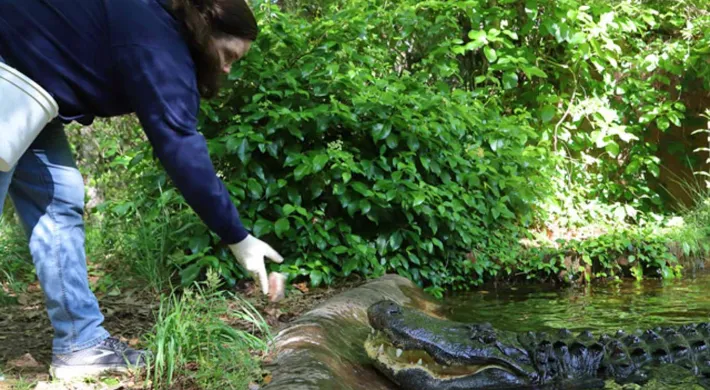

North Carolina Zoo animals are trained using positive reinforcement, a component of a learning process known as operant conditioning. Operant conditioning focuses on shaping behavior by providing consequences that encourage or discourage a given behavior.
Note: It’s important to remember that not all consequences are bad; "consequence" just means what happens as a result of the behavior.
Finding the Right Motivator
"Positive reinforcement" is when a zookeeper increases the likelihood of a behavior by providing something desirable or rewarding to an animal. Animals learn they can receive a reward or "reinforcer" by volunteering a requested behavior, but nothing bad happens if they choose to ignore a request. If an animal chooses not to participate, keepers will simply try again at another time. This process can take time and a lot of trust, but it is worth it!
Animal Care staff can use lots of different reinforcers depending on the animal or species, what’s safe for the animal and keeper, and what seems to motivate that individual animal. At our Zoo, reinforcers are often favorite food items or special enrichment treats. Some examples of reinforcers you might use with household pets could include providing rubs or scratches, participating in a fun activity (i.e. a walk), or giving treats.
At the Zoo, we focus on behaviors that help us take care of our animals. Many of our residents learn to present certain parts of their body on command to allow us to trim nails, brush teeth, or even take an injection. By giving our animals freedom of choice and encouraging them with positive attention, our animals are empowered to participate in their own health care, lowering the stress for everyone involved!
The Training Process
The goal of reinforcement is to clearly communicate to an animal when it has completed a desirable behavior we would like to see repeated. To achieve this, keepers use something called a "bridge" to help them pinpoint the desirable event. A bridge could be a word (i.e. "good") or it can be a specific noise, like a whistle or click. Clickers/whistles make a specific sound that animals can interpret over time to mean, "I did the right thing!"
To teach an animal about a clicker/whistle, the first step is to communicate that the sound of a clicker/whistle means a treat or reinforcer is incoming. Keepers pair "click-treat" until an animal looks for a treat as soon as they hear the "click" sound or whistle blast. This tells us the animal now associates the sound with something good! Once an animal demonstrates that it knows what the click means, we can begin to use the clicker to reinforce or reward specific behaviors.
To do so, we typically break a desired behavior down into little steps, then begin something called "shaping" the behavior. For instance, if a keeper needs an animal to come forward when called, the staff member might begin by giving a "click" or whistle blast whenever the animal looks in their direction. Over time, keepers will make the behavior a little more complex to achieve the desired end goal; instead of just looking at the zookeeper, the animal may eventually be required to take a step towards them, then two, then ten, until the desired behavior is complete. Once a keeper knows an animal understands a behavior, they can add a cue (i.e. the word "here" or a special bell) so the animal knows exactly what to do when they hear a sound or combination of sounds.
Using a clicker takes some patience, but once an animal knows the sound means "good job," you can use it to teach all sorts of behaviors!