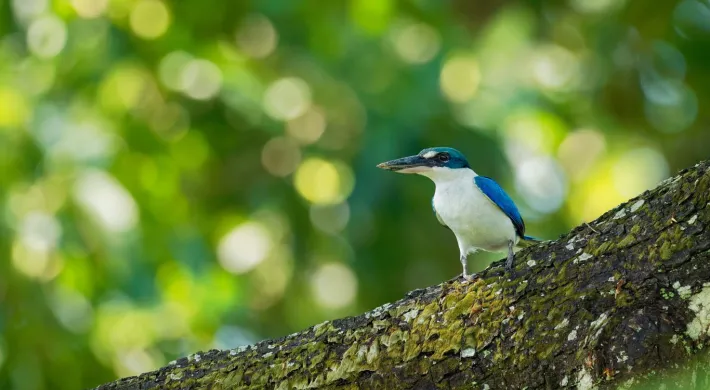
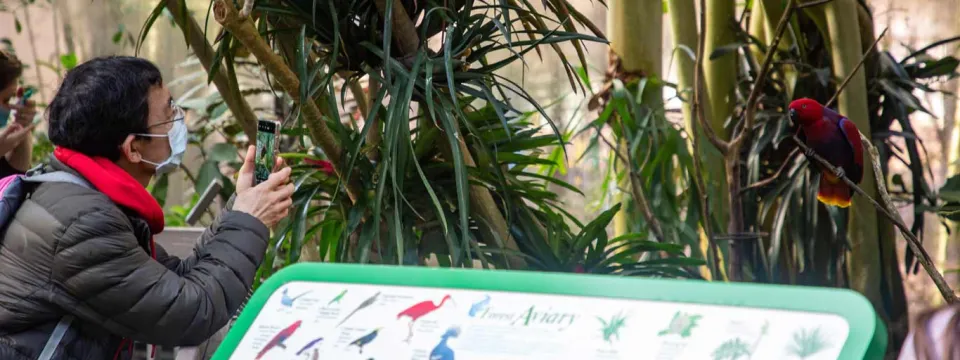
For nearly 40 years, there was a little piece of rainforest tucked away inside the North Carolina Zoo. If you were lucky enough to experience the R.J. Reynold’s Forest Aviary, you probably remember the feeling of stepping through its doors. Suddenly, you were surrounded by lush tropical greenery, the sound of birds calling, flashes of color through the trees, and the unmistakable feeling that you had wandered somewhere far from North Carolina. From the overlook near the entrance, you could watch brilliant scarlet ibis soaring through the canopy. Follow the winding paths down into the habitat and you might discover pekin robins nesting among the trees or sunbitterns wading in the pool below. And if you remember the section of boardwalk our staff affectionately called the “Drop Zone,” well… you probably know why it earned that name! Around every corner, there was something new to discover.
For generations of Guests, the Aviary was more than a place to see birds. It was a place to slow down, explore, and lose yourself in the wonder of nature. For many, it was their favorite part of visiting the Zoo. When the Aviary permanently closed in 2022, we knew we were losing something irreplaceable. We also knew that many of you never had the opportunity to properly say goodbye. So, before we turn the page on this chapter of our history, we’d like to invite you back. Come take one more walk through the rainforest with us…


A Little Piece of Paradise
When the Aviary officially opened on August 27, 1982, it was unlike anything most visitors had experienced at any zoo at that time. Rather than placing birds in individual enclosures, Guests could step directly into their world. Beneath the towering dome, dozens of species of birds flew freely among thousands of lush tropical plants, while winding pathways carried Guests from the treetops down toward the forest floor. It was a bold idea for its time, and one that helped shape our philosophy as time went on.
“The Aviary was always meant to be a completely immersive habitat where people are in the environment with the animals. And they succeeded,” recalls Crista McGee, our Deputy Director and Chief Facilities Management Officer, who has spent much of her career designing and maintaining the Zoo’s habitats. Even the carefully designed winding pathways were part of the magic. From a rocky overlook high above the forest floor, you could watch birds in the canopy. Continue down the path, and suddenly you were looking up into the very same trees. Every turn revealed a different perspective, inviting Guests to explore rather than simply observe.


That design earned national recognition. In 1983, the Aviary received Best of Show honors at the Southern Living Show in Charlotte, and in 1990, USA Today named it among the “10 best environmental exhibits” in American zoos. But awards could never quite capture what made this place so special. For Diane Villa, our Zoo’s Deputy Director and Chief Communications Officer, the Aviary was a feast for the senses. Having worked on its bird and plant illustrations and identification materials early in her career, she remembers the fragrance of tropical plants, the living wall of orchids, and the quiet pleasure of discovering something new around every bend. “If you walked through quickly, you missed a great experience,” she explained. “You needed to immerse yourself and really absorb the atmosphere.” And that was exactly what we hoped our Guests would do.
The Heart of the Rainforest
Of course, what made the Aviary so remarkable wasn’t just its innovative design. It was the incredible living community that called it home and the amazing team of people who cared for it. Over the decades, the Aviary continued to grow and evolve alongside our understanding of animal care, habitat design and conservation education. A major renovation, totaling $850,000, closed the Aviary for over a year in the late ‘90s. When it reopened in May 2000, it brought new opportunities to connect visitors with rainforest conservation, including displays about tropical ecosystems and the importance of shade-grown coffee.


Behind the scenes, keeping a rainforest thriving beneath a dome in North Carolina was no small feat! The habitat was home to thousands of tropical plants, including cacao trees, coffee trees, Brazilian grapes and other fruiting plants that provided natural food sources for the birds. It required extraordinary collaboration among animal care, horticulture, arboriculture, and facilities, design and maintenance teams. Our dedicated horticulture team cared for an astonishing collection of tropical plants, while our keepers prepared diets, monitored birds, maintained pools, provided enrichment, and kept a watchful eye for nesting activity tucked away among the branches.
For Wendy Wadsworth, our Animal Management Supervisor of Birds, the Aviary wasn’t just another habitat. It was the reason she came to the North Carolina Zoo. “The Aviary brought me here,” she recalled. “Walking into that habitat during my interview, I immediately knew I wanted this job!” Wendy went on to spend more than two decades caring for the birds that called the Aviary home. “You got lost in a tropical world,” she remembers. “… It gave you a moment to be present and mindful.”
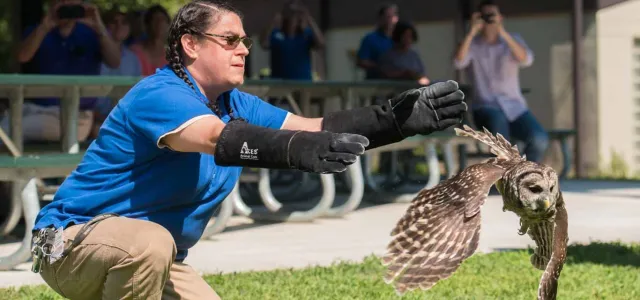
The Aviary offered something just as special for its animal residents. With room to fly, forage, nest, and raise their young, birds could express an incredible range of natural behaviors. Our keepers celebrated successful breeding programs, including a family flock of Victoria crowned pigeons. They also received recognition within the avian community for their work with passerines and spoonbills. Sometimes, the Aviary even became a second chance for injured birds that couldn’t return to the wild. Our Wildlife Rehabilitation Center would occasionally receive neo-tropical migrants (birds that would migrate to our local area during the summer then migrate to South America for the winter). If any of those birds were found to be non-releasable after receiving treatment, our Aviary provided them with a new home. One rescued male summer tanager lived in the Aviary for more than a decade!


And like any community, ours was full of unforgettable personalities. Crista remembers ‘Princess’, an Eclectus parrot who apparently had strong opinions about fashion. On two separate occasions, Princess swooped past Crista, knocked the glasses right off her face, and landed nearby as though admiring her handiwork. Diane remembers ‘Rosy’ and ‘Wilma,’ two ducks of different species who each lost their mates and found companionship in one another. The male rosy-billed pochard (Rosy) and female chestnut teal (Wilma) became inseparable after that. These are the kinds of stories that don’t usually make it onto signage and messaging, but they are moments we treasure, and the little pieces of personality that made the Aviary feel so alive.
The Aviary was also a place where collaboration made extraordinary things possible. When birds nested high in the treetops, our arboriculture team sometimes climbed 30 feet above ground to carefully bring nests with newly hatched chicks down to a protected area where keepers could help the families safely raise their young. Our hort and arbor teams maintained trees that offered not only shelter and nesting sites, but natural food sources too. Sometimes, the birds had so many delicious options growing around them that our keepers had to get creative to find something enticing enough to encourage them to participate for training!

Every branch, every nest, every bird, and every plant was part of something bigger. And caring for that little rainforest took a village.


When the Rainforest Grew Old
As much as we wished it could last forever, the very conditions that made the Aviary such a wonderful tropical habitat were slowly taking a toll on the building itself. For decades, the dome sheltered a warm, humid environment where plants flourished and birds thrived, but that constant moisture, along with the daily cleaning necessary to care for the animals, was hard on the aging structure. Our teams began investigating changes. Planters were settling. Soil was disappearing. Water was finding its way into places it didn’t belong. Even the acrylic panels overhead were deteriorating.
By the time a Victoria crowned pigeon burst through a damaged panel, Crista already knew we needed a closer look. Two separate engineering assessments ultimately confirmed what none of us wanted to hear: the building had passed its life expectancy. The geodesic dome’s aging panels were no longer manufactured, and the extensive repairs needed would cost millions of dollars and only delay the inevitable. More importantly, the structure presented serious safety concerns. One engineer recommended that anyone entering the building wear a hard hat. We could no longer safely welcome Guests into the rainforest we had spent so many years nurturing.


The timing made the already painful situation harder. When the Zoo reopened to the public following its initial COVID-19 closure in 2020, indoor habitats, including the Aviary, had to remain closed for some time. Later, in January 2022, the Aviary had to be closed as a precaution against highly pathogenic avian influenza to protect our birds. Then, on April 21, 2022, we announced that the Aviary would close permanently because of its structural condition. For many of our Guests, that meant there would be no final visit. The goodbye came before anyone realized they needed to say it. In August of 2026, demolition work began, and it should be completed by the end of this year. As the structure we loved for so long comes down, we are reminded just how much this special place meant to all of us.
We Loved It, Too
We know how much the Aviary meant to so many of you. We have heard stories of childhood visits, favorite birds, and quiet moments spent beneath the dome. We understand why losing it has been so difficult. What we hope you also know is that saying goodbye was heartbreaking for us, too. When asked how she felt about the closure, Wendy had just one word. “Devastated.”




After more than 20 years caring for the Aviary’s residents, she and her team faced the enormous task of finding appropriate new homes for their animals. Some birds could remain at the Zoo, moving to other habitats or behind the scenes facilities. Others would need to travel to zoological institutions across North America. “It was heart breaking for the keeper team to say goodbye to so many birds, all at the same time. The task to move all the birds from the aviary was physically and emotionally challenging. We all came together and dug deep to find the strength to make it happen. I am still in awe of the team’s resilience,” Wendy recalls.


Our hort and arbor teams also faced the loss of a plant collection they had spent decades nurturing. Plants were carefully relocated, donated, or preserved where possible. And for those whose work involved designing, maintaining, and caring for the building itself, there was the difficult knowledge that something they loved could no longer be saved. Diane remembers the Aviary as her refuge, a place she could retreat to when she needed a moment of peace. “The Aviary was always where I could go to find peace or restore myself,” she says. “It hurt to see it close.” Crista remembers it as her favorite habitat at the Zoo.
For the people who spent their careers within its walls, the Aviary was never simply a building. It was where they learned, laughed, celebrated new life, solved problems together, and built relationships with animals and colleagues alike. And when the time came to let it go, they grieved alongside you. “Know that none of us wanted it to close, but it was unavoidable,” Diane says. Sometimes, loving something means accepting that we cannot keep it forever.


Hope for the Future
When we announced the Aviary’s permanent closure in 2022, the response from our community was overwhelming. So many of you shared your disappointment and how much this place meant to you. Your voices were heard. In response to that public outpouring, former North Carolina Representative Pat Hurley advocated for funding to replace the Aviary. Ultimately, $60 million was secured for a new aviary project, giving us the opportunity to imagine how we might bring that rainforest experience back for future generations.

The ideas that made the Aviary so revolutionary in 1982 continue to inspire us as we plan for the future. Our new Asia region (opening in March 2027) includes a smaller aviary, where guests will have the opportunity to reconnect with some familiar faces, including Bali mynahs, and some plants you’ll recognize from the original Aviary. That space will also help us share important conservation messages, including the challenges facing Asian songbirds. But we are looking even farther ahead!
Plans are underway for a future Amazon development, with an immersive aviary component that would build upon the original habitat’s philosophy. In addition to the free-flighted birds, the concept would also add small mammals, reptiles, and amphibians to more closely represent the complex relationships found within a natural ecosystem. We’re also being thoughtful about where this new experience will take shape. Although our Amazon expansion was originally envisioned for another area of the Zoo, we’re now planning to build near the original Aviary site. By making responsible use of the land already developed, we hope to minimize our impact on surrounding natural habitats. It’s one more way we are working to be good stewards of the land entrusted to our care. There is still much planning to be done, but our hope is to carry forward the sense of discovery and wonder that made the original Aviary so extraordinary.
For Wendy, that hope includes the possibility of welcoming some of the bird species she used to love and care for back to the Zoo someday. “It will be like bringing back old friends,” she says. We like to think the Aviary’s greatest legacy isn’t the dome itself, but everything that happened beneath it. The conservation accomplishments. The generations of birds raised in its trees. The people who dedicated their careers to its care. The children who stood beneath the canopy and discovered a lifelong love of wildlife. And the countless memories made along those winding paths.

One Last Walk
So, before we say goodbye, let’s take one more look around. Imagine yourself back at that overlook, where the scarlet ibis are gliding through the treetops. The air is warm and fragrant. Somewhere ahead, a Bali mynah calls. As we follow the winding paths, you gently squeeze the cone of a bright red awaphui plant and smell the aromatic soap-like liquid it releases. Stop for a moment and admire a group of blue-crowned hanging parrots among the branches. Farther down, we hear the water and see Rosy and Wilma splashing about together. Maybe Princess is somewhere overhead, looking for another fashion faux pas to correct. We pause beneath the rocky overhang, looking out at the little world we’ve come to love.

For a moment, we can almost forget that this is goodbye. But eventually, the path leads us toward the exit. And this time, we know it’s our last walk through. The R.J. Reynold’s Forest Aviary gave us nearly 40 years of wonder. It taught us about the natural world, inspired us to protect it, and reminded us how extraordinary it can feel to simply be surrounded by life. We won’t walk through those doors again, but we will carry the memories with us. Thank you for loving this special place as much as we did and thank you for walking through it with us one last time.
Goodbye, old friend.